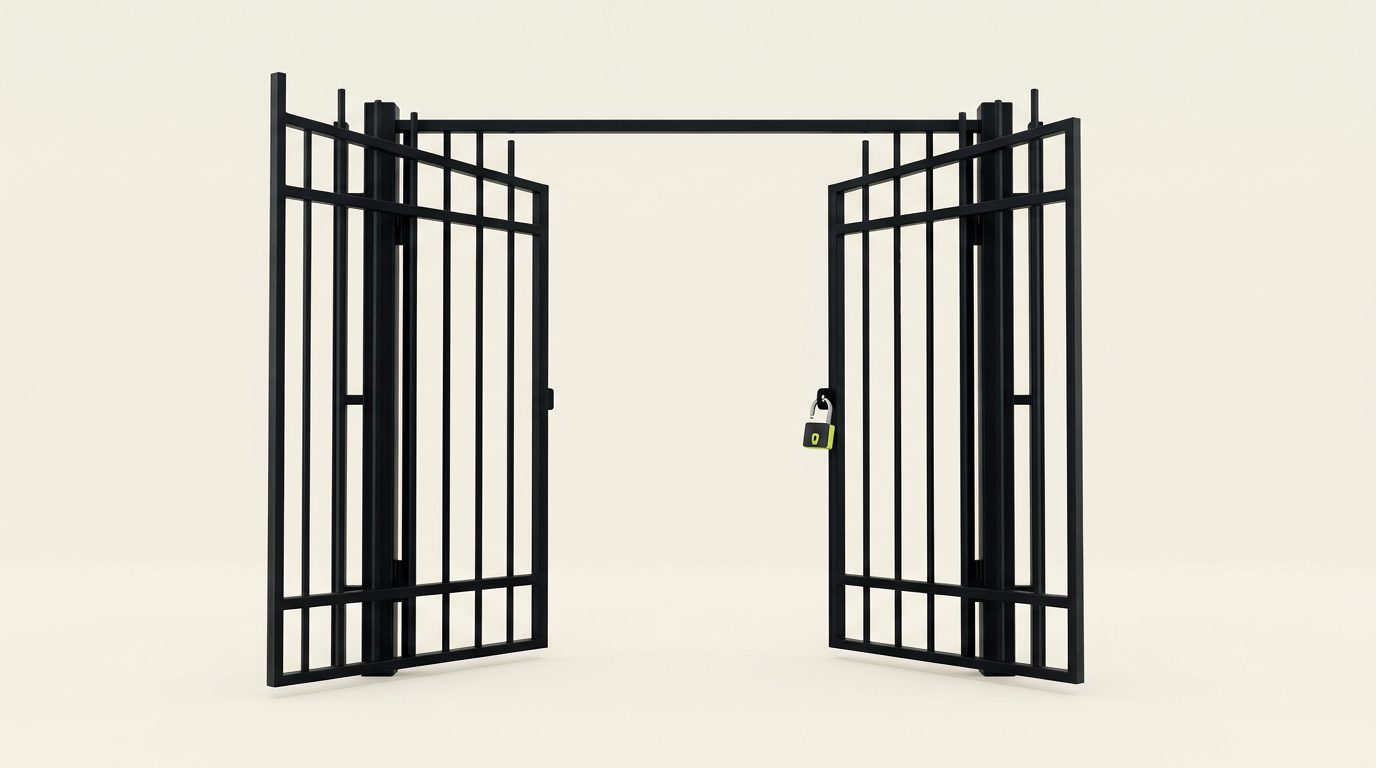
There's an image I keep coming back to. A tall iron gate — ornate, hinged, padlocked — standing in the middle of an empty field.
No wall on either side. No fence running away from it in either direction. Just a gate, bolted shut, guarding nothing. And a worn path leading up to it.
The path is the part that matters. Somebody walked up to that gate often enough to wear a line in the grass. They walked to the locked door, stopped, and went back the way they came. Then they did it again the next day, while the whole field sat open either side of them.
I've never seen a better portrait of the last decade of building things.
The gate was real
It's fashionable now to call the old order gatekeeping — an elite protecting its access out of self-interest. That reading feels good and it's mostly wrong. And the reason it's wrong matters, because a villain is easier to wait out than a structure.
For most of my working life, getting software built took several specialists at once. A designer. An engineer. Someone to run the infrastructure. Someone to sell the finished thing. And a person to hold the whole affair together and keep it pointed in one direction.
None of those people were rare on their own. All of them were expensive in combination, and every one had to be paid every month while the outcome was still unknown.
That distinction isn't a technicality. A conspiracy is a moral story, and moral stories have villains, and villains can be shamed or replaced or outlasted. Arithmetic is a structural story with a price attached. Until the price changed, no amount of deserved frustration moved the gate an inch.
Which means everyone who stood at that gate and quietly decided the thing they wanted wasn't for them was reading the situation correctly. That's what makes it worth revisiting now.
What the gate actually charged
The fee was never the money. Money was just the visible part of the invoice.
The real charge was the idea.
Say you had a clear picture — a specific tool for a job you did every week, a specific book you wanted to exist, a specific way of handling scheduling that was obviously better than the way everyone handled it. To get it built, you had to hand that picture to strangers and hope it survived the journey.
It rarely did. The picture became a brief. The brief became requirements. The requirements became estimates, the estimates became a scope, the scope became a queue of work — and the queue became something that shipped late and didn't match what you'd imagined.
Every step in that chain is a translation, and every translation loses precision. Nobody in the chain is incompetent. Nobody deletes your vision on purpose. It just erodes, like a sentence whispered down a line of ten people, except the game runs for eight months and costs a small fortune to play.
The gate charged money. The translation charged the idea. And the idea was the only irreplaceable part.
What removed the wall
Sometime in the last few years, the arithmetic changed.
Not because anyone opened the gate. Not because anyone declared it open. Because the cost of producing the work collapsed.
The parts of building that were pure production — the boilerplate, the first draft, the layout, the rough cut, the setup, the testing, the twenty small technical chores that fill the space between an idea and a finished thing — got fast. And the fast parts were exactly the parts that made a crowd necessary.
Building anything meant assembling expensive specialists and paying them every month while the answer was still unknown. Capital was the entry fee.
The same work, without the crowd. The barrier is gone. What is left is the habit of queuing at it.
The part nobody warns you about
When the gate opens, almost nobody walks through. That's the honest finding, and it isn't a criticism of anybody.
We're trained to wait for permission. Not by a villain — by a lifetime of queues that were real. School, hiring, funding, publishing, the bank. Every one of those taught the same lesson: the decision isn't yours, wait your turn, and the turn will be granted by somebody else.
So when the wall comes down, the first thing most people do is keep standing at the gate, waiting for someone to tell them it's fine.
Nobody's going to. There's no queue to legitimise the decision anymore, and that's uncomfortable in a way that's easy to mistake for a reason to wait. It isn't. It's just the feeling of being the first one through.
The new constraint
If permission isn't the blocker, what is?
- Clarity. Do you actually know what you want, specifically enough that somebody could build it without asking a follow-up question?
- Willingness to act without a queue. Can you decide before someone else tells you the decision is reasonable?
- Tolerance for being early. Nobody's going to validate it for you, because most people are still standing at the gate.
Notice that all three of those are yours. Not capital, not credentials, not a team you can't afford. The gate is gone and what's left is a decision.
- The gate was real
It was arithmetic, not a conspiracy — which is why waiting never helped.
- The price changed
The production work that required a crowd is now fast, so the gate no longer guards anything.
- The new cost
Waiting used to cost capital you did not control. Now it costs time, and the time is yours.
The cost of waiting used to be paid in capital, which you didn't control. It is now paid in time, which you do.
That's the entire change, and everything about how you should behave follows from it.
What did your business stop asking for?
Somewhere in your business there is a worn path. It leads to a thing you once priced and gave up on: software built around the way you work, a film, a book, a marketing department. The quote was absurd for a company your size, so you stopped asking.
You were right to stop. But the decision has outlived the price that produced it, and nobody sends a letter when that happens. So walk the path again, and count what the waiting costs. The essay says it is now paid in time.
What are your options now the wall is gone?
Is DoubleUp the right way through?
DoubleUp is the staffing arm of the company that built and owns SuperCool, an AI platform. It runs on the new arithmetic: one person where there used to be a crowd, with the platform doing the production. You can have that person by the month, as an AI Engineer, Marketer, Creator or Operator. Or you can hand us one whole job with an end: an app, a book, a film.
This is for you if
- There is a specific thing you gave up on getting built, made or run, and you can still say what it was.
- You do the production yourself, late, because a team for it never added up.
- You would rather correct a working version than approve a long proposal.
It isn’t, if
- You want someone to tell you what to want. The picture has to start with you.
- You need the outcome promised before you begin. Nobody honest can promise work that hasn't been run.
- The work needs a person on site, all day.
- You'd enjoy learning to build it more than having it. Then do that: the field is open to you too.
What is still keeping you at the gate?
If the gate is really open, why isn't everyone walking through?
Because habit outlasts price. The queue was real for so long that waiting for permission still feels like prudence. The same tools are open to every competitor of yours, and most still work the way they always did. That lag doesn't mean the field is closed. It is why being early is still worth something.
This sounds too easy. What's the catch?
The hard part moved. Production got cheap and clarity didn't. If you can't describe what you want well enough for someone to build it, a lower price only gets you the wrong thing sooner. Deciding, describing and checking are still yours, and none of them can be bought.
Won't the tools soon do this without a person?
They will keep taking over production, which is the essay's argument, not a reply to it. Each step they absorb makes the rest, knowing what to ask for and whether the answer is right, a bigger share of the result. Waiting until no person is needed is one more gate to stand at.
I already have people. Why would I need a specialist?
You may not. If your team already does the thing you wanted, there is no path to revisit. The useful question is narrower: which jobs did you stop asking them for, because they needed skills or hours the team doesn't have? Those are the ones the old arithmetic ruled out.
I paid for something like this once and it went badly. Why try again?
Most of those stories are the translation chain at work: the picture passed through several hands, and what came back wasn't it. That is a reason to change the structure, to fewer hands and earlier working versions. Before you pay anyone, ask exactly how you would stop and what you would keep. Our own answer is in the next question.
What does it cost, and what am I signing up to?
This essay states no prices for a specialist, so none are added here. They are on the page called What Is DoubleUp?, with the terms for stopping. Read it before the call. One part can be said now: what was built is yours. If you stop, you have two choices: keep it running on SuperCool, which is $97 a month for hosting plus credits, or download everything and set it up again yourself on whatever you want to use. The old gate hid its price behind a quote. If ours doesn't suit your business, you'll know without talking to anyone.
Why not wait and see how this plays out?
Under the old arithmetic waiting was free, because the capital was never yours to spend. Now the only thing it spends is time, and that is yours. If the thing has no value to the business, wait. If it has, every month without it carries a cost, and the calculator above will estimate it.
Nobody is going to announce that it's your turn. That was the point of the field. If you want the prices before you talk to anyone, they are in What Is DoubleUp?