Think about the last hundred leads your company paid for. Somebody filled in a form. A rep called, got no answer, called again, sent a text, sent an email. Some of those people picked up eventually. Most didn't. And the ones who did were talking to you two days after the moment they actually wanted to talk.
Nobody on your team did anything wrong. That's just what the usual sales funnel is: a long line of small steps, each one reasonable, each one losing a few more people. By the time a rep is finally giving the pitch, most of what you paid for is gone.
We ran that funnel ourselves, lost the same leads, and built something to stop it. This article explains all of it: what the system is, why each part exists, what it's like on both sides of a call, who does what, and what it isn't.
The usual way a lead becomes a conversation
Write out what really happens between an ad and a pitch and it looks like this.
- An ad
- A lead form
- Into the CRM
- An email
- A text
- A call
- Another call
- A short conversation to book the real one
- A calendar invite
- Back into the CRM
- A no-show
- A reschedule
- Another call
- The pitch
Fourteen steps. Every arrow between two of them is a place where a buyer stops answering. The form asks for too much. The first call comes while they're driving. The email goes to promotions. The booked call is on Thursday, and by Thursday they've talked to somebody else.
And every one of those steps is a tool. A page builder, a form, a CRM, an email tool, a texting tool, a dialer, a scheduler, a video link. Somebody has to buy them, connect them, and get your reps to actually use them.
What does a slow funnel cost you?
You pay for every lead, whether a rep ever speaks to them or not. The ones nobody reaches don't appear as a loss on any report. They get called bad leads, and the usual answer is to buy more of them.
So leaving it alone costs you twice: once at the ad platform, and again in rep hours spent chasing people whose interest has already passed.
The Digital Walk-in
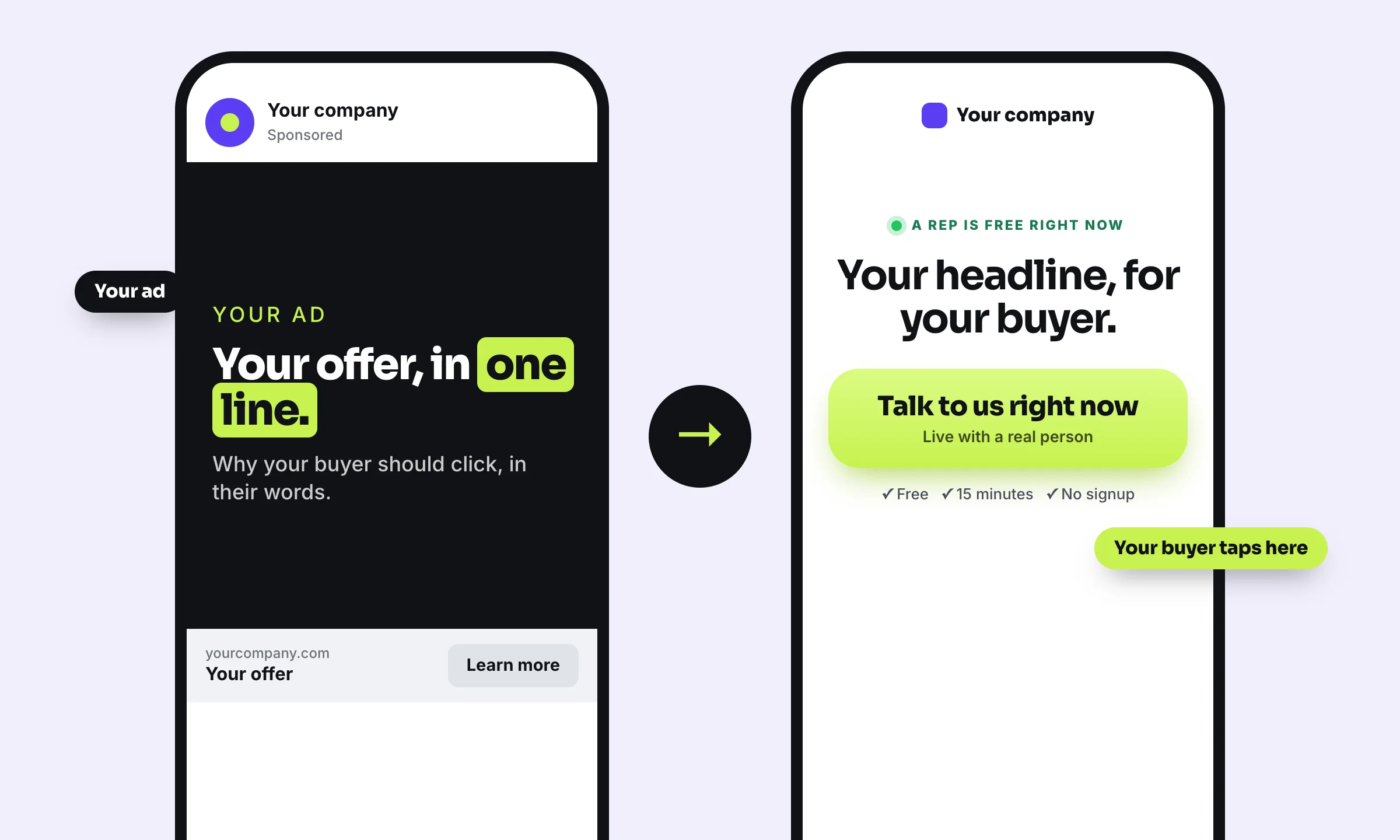
Here is the other way. A buyer sees your ad. They press one button on your page. They are on a live call with one of your reps.
That's it. We call it a Digital Walk-in, because it's the online version of someone walking into your store: they came in on their own, they're interested right now, and a person is standing there to help them.
A form, then chasing. The conversation happens when a rep finally reaches them, with whoever is still interested by then.
One button. The click is the conversation, with the buyer at the moment they wanted to talk.
A few things make that work in practice. The buyer taps once, in the browser they're already in, on a phone or a computer. There's nothing to download and no link to find. And because nobody dialled them, there's no unknown number for them to ignore.
The live button only shows when one of your reps is free to take the call. When nobody is, the same page books the buyer a time, and the reminders go out by themselves. So nobody presses a button and waits in an empty room, and your hours stay your hours.
Two numbers decide a sales team
Strip everything else away and a sales team comes down to two numbers: what a conversation costs you, and how many conversations close.
Start with the first. Today you pay for a click, then for a form, and then you pay again in rep time to chase it. By the time a rep is talking to someone, that conversation has cost many times what the click did. When the click is the conversation, most of that cost is simply not there.
Here is an example, with made-up round numbers, to show the shape of it. Say a click on an ad costs two dollars. The usual way, after the form and the chasing, one click in twenty-five ends up talking to a rep. The other way, say one in two presses the button and talks.
| The usual funnel | Digital Walk-ins | |
|---|---|---|
| A click on the ad | $2 | $2 |
| Who ends up talking to a rep | 1 in 25 | 1 in 2 |
| A conversation costs | $50 | $4 |
| They buy at | 40% | 60% |
| A sale costs | $125 | About $7 |
The second number is the close rate, and it moves for a different reason. RAIN Group's research on more than a thousand sellers and sales managers found that top performers win 72 percent of the deals they propose. Everyone else wins 47. Same products, same prices, same leads. The difference is what the top sellers say.
Every sales team already knows this. You have one or two reps who close far more than the rest, and you've wished for years that you could copy them. That's the second half of what the system does.
What are the other ways to fix a sales funnel?
Strip everything else away and a sales team comes down to two numbers: what a conversation costs you, and how many conversations close.
You have probably bought some of these already. Each is a reasonable purchase, so it's worth being exact about which of the two numbers it moves.
Three things, nine jobs
The whole system is three things, and each of them is three jobs. This is what's actually in it, and what each job usually takes when you buy it tool by tool.
| The job | The usual way to get it done |
|---|---|
| A page and ads for one offer | A page builder and an ad agency |
| A free rep rung in seconds | A lead router or a dialer |
| A live call straight from the page | A scheduler and a video tool |
| The script on screen, word for word | A script in a document |
| Slides the buyer sees | A slide deck |
| Every objection's answer, one tap away | Training, and hoping |
| Signed and paid on the call | E-signature and invoicing |
| Follow-up and no-show rebooking | CRM sequences |
| Calls reviewed, ads told who bought | Call recording and tracking |
1. Every lead talks to a rep in seconds
Most teams already call their leads. The difference is when. A page and ads built for one offer, a free rep rung when someone presses the button, and a live call that starts on the page itself. That is why a rep ends up talking to more of the leads you already pay for.
2. Every rep gives your best pitch
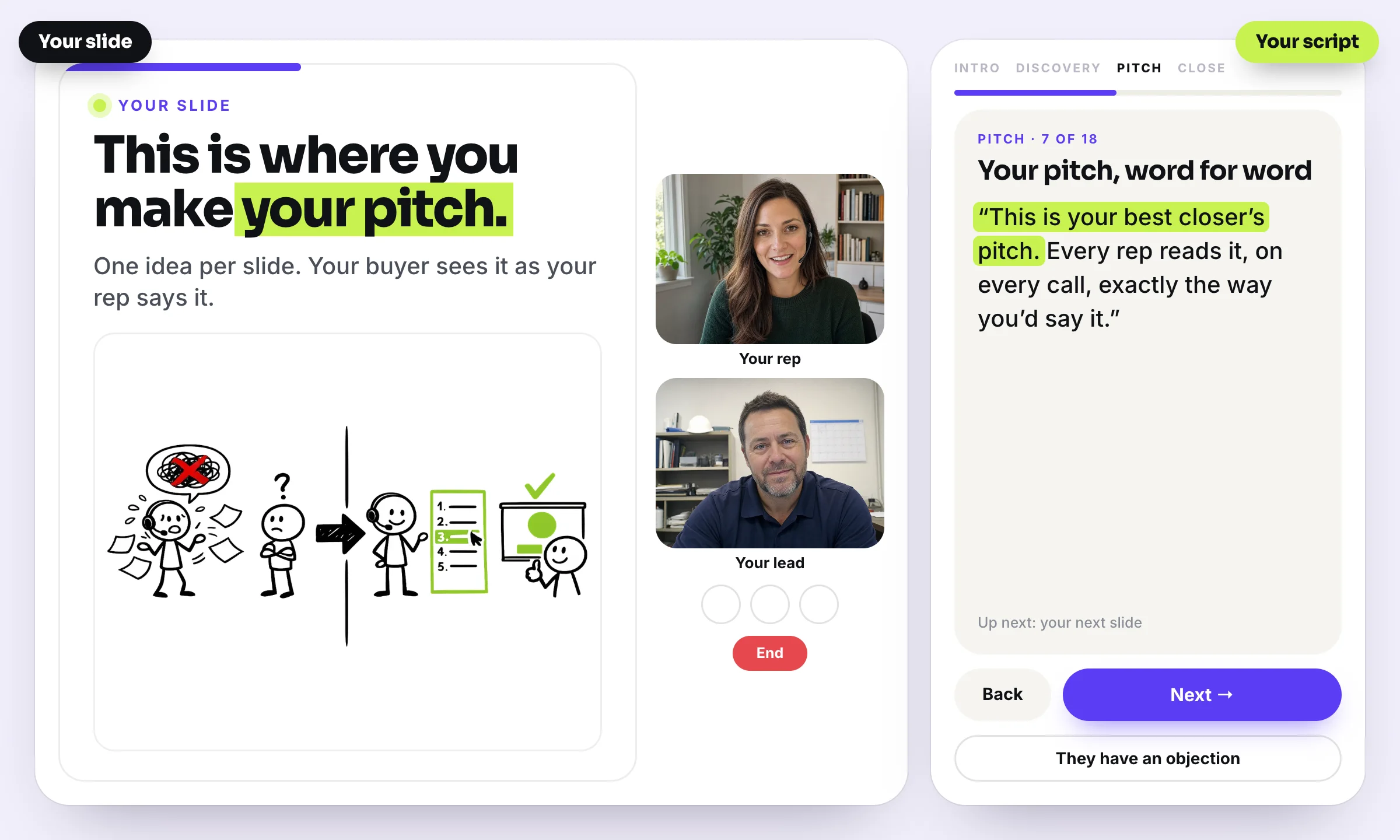
Your best rep's pitch goes on every rep's screen, word for word, with the slides your buyer sees and the answer to every objection one tap away. A rep in their first week says it the way your best one does.
3. Every deal closes or gets followed
Your agreement is signed and paid on the call. Anyone who doesn't buy is followed up and rebooked without a rep having to remember. And every call is recorded and reviewed, so you know what was said on it.
What your buyer sees, and what your rep sees
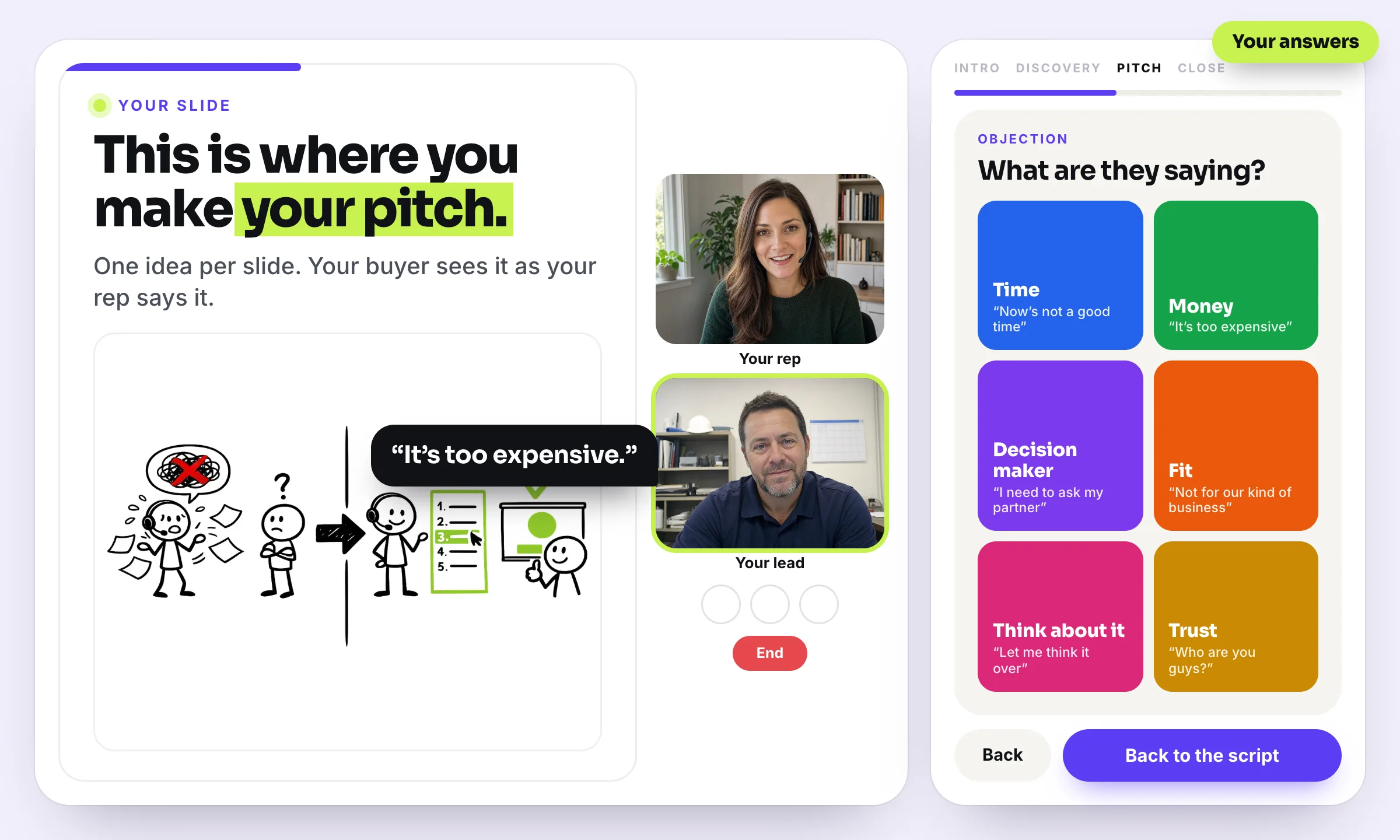
On a call, the buyer's screen is simple: your rep's face, and one slide at a time. One idea per slide, in your words. No dashboard, no menu, nothing to learn.
The rep's screen has the same slide and both faces on the left. On the right is the script: where they are in the call, the line to say, and a button for the next one. Nobody wonders what comes next, and nobody improvises the price.
Under the script is one more button, for the moment the buyer says something that isn't yes. "We already have tools." "It costs too much." "Let me think about it." The rep taps what they heard, and your best answer to it is on their screen, with a slide for the buyer, before the pause gets awkward.
The script and the slides are yours, not ours. We draft them from your own page and from what your best rep actually says, and they're changed whenever your offer changes.
Signed and paid on the call
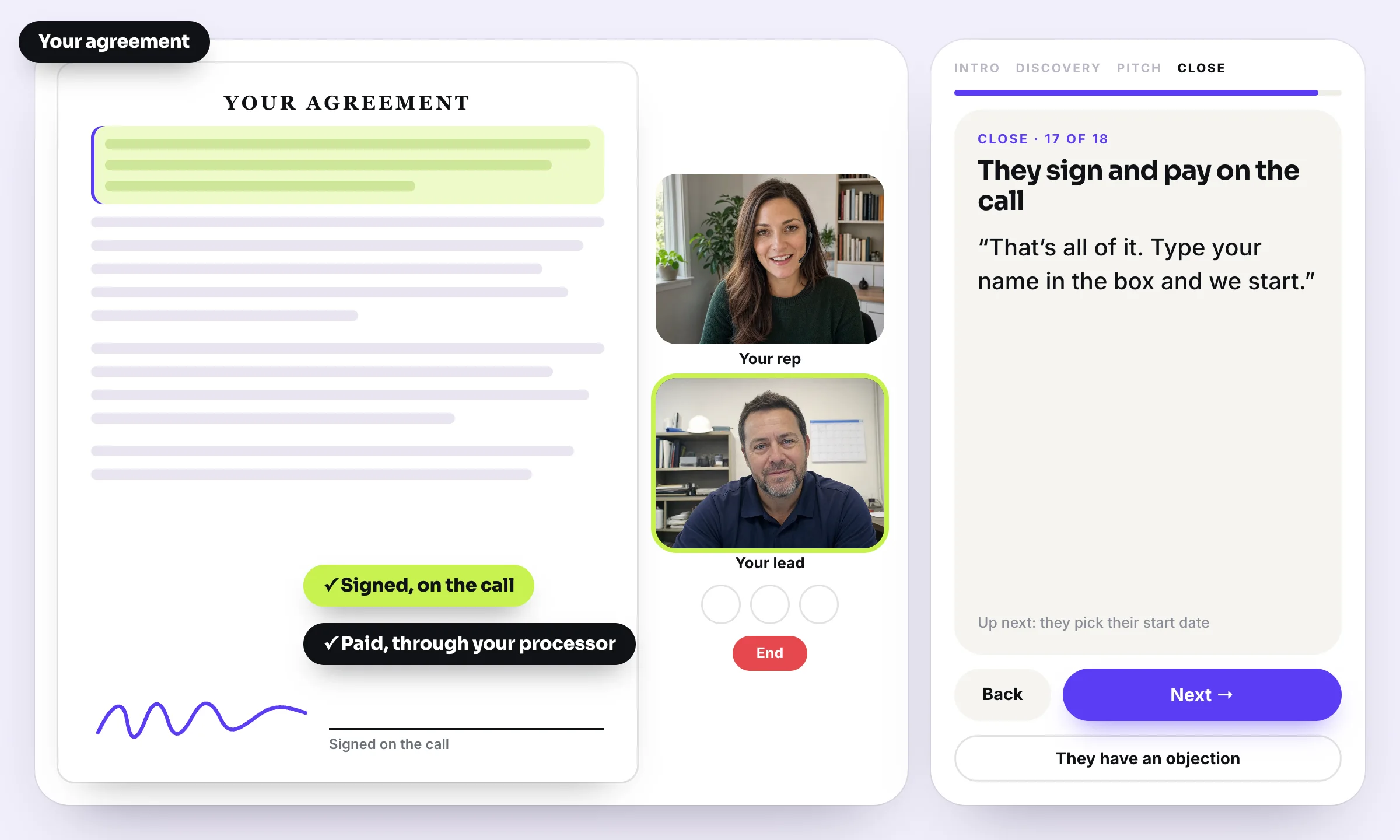
How many of your deals go quiet between "yes" on the call and a signature three days later? That gap is where a lot of closed deals quietly reopen.
In the room, the agreement comes up on the buyer's screen while your rep is still there. They read it, type their name, and pay. It is your agreement, word for word, and the money goes through your own payment processor to you. We don't write your agreement, and we never hold your buyers' money.
After the call
Not everyone buys on the first call, and some people miss the call they booked. The system assumes that. When a next call is needed it's booked before this one ends, on a calendar that's in the room. Reminders go out by text and email before it. Someone who misses their call is sent a link to rebook. No rep has to remember any of it.
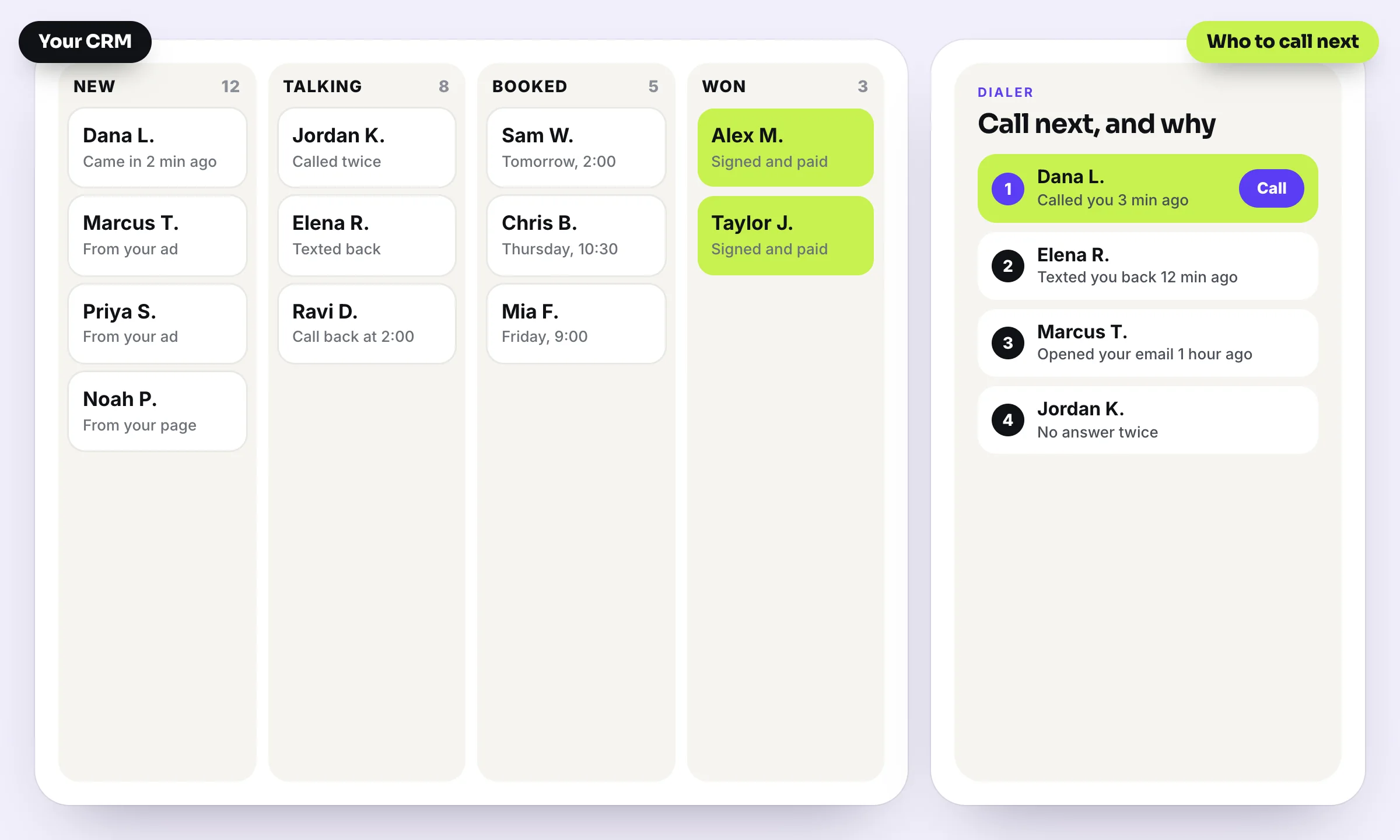
Behind the calls is a CRM: every lead on one board, from the form they filled in, to the first call, to signed and paid. Every text, email and call with a lead is in one thread, with the rep's open times beside it, so "call me after three" is one tap to book.
And if you want your reps dialing, the dialer does the choosing. It works out who to call next and puts the reason beside the name: this one texted back twelve minutes ago, this one's first call is due, for this one the front desk answered so try for the owner.
What a manager gets
You manage reps you can't listen to. That's the real problem of running a sales team, and it's the one most tools leave alone.
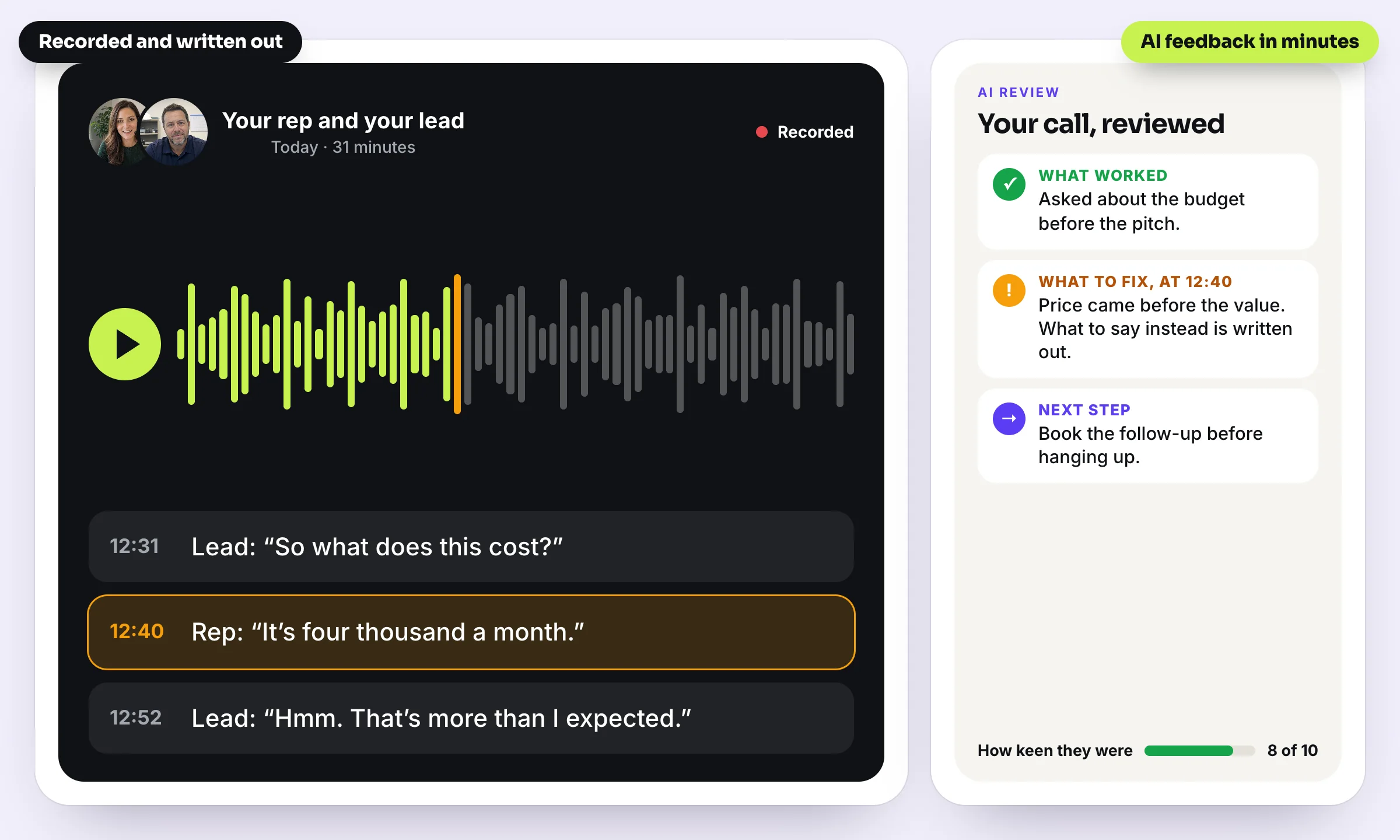
Here, every call's sound is recorded and written out. A few minutes after it ends there's a review of it: a score, what worked, the moments that hurt the sale with what to say instead, and the next step with that buyer. You read it, and send it on to the rep when you want them to have it.
So you stop guessing who follows the script. You know what was said to your buyers on every call, without listening to every call. And your ad platforms are told who booked, who showed and who bought, so they go looking for more buyers and fewer form-fillers.
Who does what
This matters more than any feature, so here it is plainly.
- We build the system for your offer: the page, the ads, the call room, the script, the slides, the answers and the follow-up.
- Your own reps take the calls. Ours don't.
- You run the ads and pay for them, so the budget is always yours.
- Your buyers sign your agreement and pay your payment processor.
- The data about your leads, your buyers and your calls is yours.
What it isn't
It doesn't shorten a long sale. If your deals take three calls and a procurement review, they still will. What it does is make sure every one of them starts, and none of them goes quiet between calls.
It isn't a replacement for a CRM you love. You don't have to rip anything out. Think of it as the part in front: the page, the call, the pitch and the close.
It isn't magic without your reps. A buyer goes straight onto a call when one of your reps is free. When none is, they book a time. The system makes the most of the hours you staff. It doesn't staff them.
And we'd rather say what it doesn't do than have you find out later. It records the sound of a call, not the video. The replies it drafts are drafts: a rep reads them and sends them.
Who is the Sales System for?
This is for you if
- You pay for leads, and a rep only ever speaks to some of them.
- Your sale is made in a conversation, and you have your own reps to hold it.
- One or two of your reps close far more than the rest, and you want the others giving the same pitch.
- Deals go quiet between a yes on the call and the signature.
- You manage reps whose calls you can't listen to.
It isn’t, if
- Your buyers pay at a checkout without talking to anyone. There is no call for the system to start.
- You have no reps, or you want ours to take your calls. Ours don't, and the system doesn't staff your hours.
- Nobody on your side will run or pay for ads. We build the page and the ads, and the budget stays yours.
- Nearly every lead already gets a conversation, and your reps close about as well as each other. There is little left for it to move.
- You need a price in writing before you'll talk to anyone. Pricing is gone through on the demo call.
How you'd start
Not with the whole company. With one offer, and the team that sells it.
The first step is to see it, and the honest way to see it is from the inside. Press the button on our page and you're in the same room your buyers would be in, talking to one of our people. From there it's a demo call with whoever else decides and with your best rep, where your own offer is on the screen and your own numbers are in the sum. Pricing is part of that call, because it depends on what you need.
What happens, in order
- You try it as a buyer
On our own page, with one of our people.
- A demo call with the people who decide
Bring your best rep. Your offer is on the screen, your numbers are in the sum, and pricing is part of the call.
- We build it for one offer
The page, the ads, the call room and the follow-up, with a script, slides and answers drafted from your page and your best rep's words.
- Your reps take the calls, and you read the reviews
What you change next comes from what was said on real calls, not from a guess.
Why we built it
We didn't set out to make sales software. We set out to sell, and we were losing leads in the same fourteen steps as everybody else.
So we built the room, then the script beside it, then the agreement inside it, then the review after it. We sell on it every day. And because it's one system, testing a new offer stopped being a project: it's a new page, a new script and new slides, not a new stack. We've launched new offers on it days apart.
That is the whole reason it's for sale. It works on us.
What buyers ask before they decide
We've bought sales software before and the reps stopped using it. Why would this be different?
Most sales tools are a second screen a rep has to remember to open. Here the call happens inside the system, with the script beside it, so taking the call is using it. Every call is reviewed, so you can see who follows the pitch without sitting in. If your reps refuse to take calls in the room at all, nothing here fixes that.
Does it work for what we sell?
It fits a sale a person makes in a conversation, whether your buyer is a business or a consumer. The script, the slides, the answers and the agreement are written for your offer, so nothing of ours carries over. It fits badly where nobody needs to talk before buying, and it won't make a long sale shorter.
What happens to the tools and the data we already have?
Nothing has to be ripped out. The system sits in front of the CRM you have. What this page can't tell you is whether your leads can be moved across from a particular tool, or whether it connects to yours. Ask on the demo call, by the tool's name, and get the answer in writing before you decide.
How long until it's running?
We don't publish a number of days, because it would be a guess until we've seen your offer. The build is ours to do. From you we need your best rep's pitch, your agreement, and time for your reps to learn the room, and the pace depends a good deal on how quickly those arrive. Ask for a date on the demo call.
What if it doesn't pay for itself?
Then you'll know, because it comes down to two numbers you already have: how many of your leads get a conversation, and how many of those close. Write both down before you start. This page makes no promise about either. What limits your risk is how it starts: one offer and one team, not the whole company. If the sum on your own numbers doesn't work on the demo call, don't buy it.
Will a buyer really press a button to talk to someone right now?
Some won't, and they don't have to: the same page lets them book a time. The ones who press are the ones who wanted to talk at that moment, the group the usual funnel reaches days later. You can test how it feels by doing it yourself on our page.
Is an AI talking to our buyers?
No. The live call is your rep and your buyer, two people on video. Software does the work around it: it writes out the recording, writes the review, sends the reminders and drafts replies, which a rep reads before sending. If you were hoping for something that sells without reps, this isn't it.
We don't get many leads. Is there any point?
The fewer leads you have, the more each lost one costs, so there may be more point, not less. A page and ads for your offer are part of what we build. But you run those ads and pay for them. If there is no budget to send anyone to the page, the button has nobody to press it.
Questions people ask
We already have a CRM. Is this instead of it?
No. A CRM is a filing cabinet. It remembers every lead perfectly. It doesn't get one of them on a call, and it doesn't put your pitch on a rep's screen. This is the part in front of it: the page, the call, the pitch and the close.
My reps won't follow a script.
Your best ones don't need one. The script is for everyone else, so they give your best rep's pitch. And because every call is reviewed, you'll know who's using it without guessing.
Our sale takes more than one call.
Most serious sales do. But however long yours is, it starts with one conversation, and the team that has that conversation first usually has the rest of them. The next call is booked before this one ends.
What happens after hours, or when every rep is busy?
The live button only shows when one of your reps is free. When nobody is, the same page books the buyer a time and reminds them. Nobody waits in an empty room.
Do your reps take our calls?
No. We build the system; your own reps run it. Your buyers are talking to your people.
Does a buyer need to download anything?
No. One tap, in the browser they're already in, on a phone or a computer.
Whose data is it?
Yours. Your leads, your buyers and your calls. What we build for your offer is yours too. The platform underneath stays ours.
What does it cost?
We go through pricing on your demo call, because it depends on what you need. The first call costs nothing and puts you inside the system.