
There's a folder on a lot of laptops called "Book." Inside is a document that's somewhere between a third and all the way finished. It's been there for two years.
The reason is almost never the writing. People who start books are usually people who can write. The reason is everything that comes after: a list of jobs nobody told them about, each one unfamiliar, each one a place to stall. Typesetting. ISBNs. Categories. A cover that also has to work as an audiobook square. A website, because a book with no list behind it sells a handful of copies.
This article goes through all of it. Every step, what it involves, what it costs to do the other ways, and what changes when one team does the whole thing.
What does the folder cost you?
Nothing you can see, which is why it can sit there for two years. But a manuscript in a folder does none of the things you wanted the book for. Nobody can buy it, quote it or hand it to a client.
Before
A manuscript in a folder
- Somewhere between a third and all the way written.
- No cover, no ISBN, no page on Amazon.
- Nobody but you has read it.
- No list of readers to tell when it's ready.
After
A published book
- Edited, typeset and on sale in print, eBook and audio.
- Registered under your own imprint, with your copyright.
- One click away on Amazon, Apple Books, Barnes & Noble and your own site.
- An author site, a list and a CRM, so buyers become subscribers.
- A launch week behind it, and your first podcast.
The ten steps
Every major publisher follows the same stages. So does every self-published book that sells. Here they are, in order.
1. Complete your manuscript
This is the writing part. There's no perfect answer for when your book is done, but every major publisher follows the same stages.
- Get your full draft into one master document
- Do a plot & structure edit
- Line-by-line voice edit
- Hire a human editor (you won't catch everything)
- Grammar edit: no typos allowed
- Final-final-final check before formatting
2. Manuscript formatting & typesetting
This part is technical, tedious, and totally doable. You'll need digital and physical formats.
- Prep your manuscript for formatting
- Choose your formatting software
- Set genre-specific margins & page size
- Select fonts & layout styles
- Create an ePub file
- Export your print-ready PDF
3. Cover design & 4 formats
This is your first impression. Be a purple cow: bold, original, unforgettable.
- Create your cover concept
- Choose your design tools
- Calculate exact dimensions (based on page count)
- Format for print, eBook, and audiobook
- Test how it reads as a thumbnail
- Finalize your spine & back cover copy
4. Create, edit & publish an audiobook
Upload and sell your audiobook.
- Choose your production platform
- Select voice talent
- Record & edit (or hire it out)
- Choose your audiobook distributor
- Upload + test the checkout flow
5. Own your book: copyright, ISBNs & your imprint
The paperwork nobody warns you about. Get it wrong and your book can't be sold.
- Register your publishing imprint
- Purchase ISBNs
- Assign ISBNs to each format
- Generate barcodes
- Register copyrights
6. Amazon keywords, categories & positioning
You only need ~10 sales to become a Bestseller. But the right metadata is everything.
- Research bestseller categories
- Analyze your competition
- Pick launch keywords
- Track & test keyword performance
- Update categories regularly
7. Publishing: upload to all platforms
Your book should be one click away: on Amazon, Apple Books, B&N, and your website.
- Choose a distributor
- Set up accounts
- Upload your files
- Set your pricing
- Enable pre-orders
- Test the buy button
8. Author funnel + owning your list
Every buyer should become a subscriber. That's how you build a real brand.
- Choose a website builder
- Write your content
- Design the site (or hire someone)
- Connect Stripe & email
- Link your books
- Test the full funnel experience
9. Author CRM: fan communication
A funnel collects names. A CRM is what stops them falling through the cracks.
- Choose a CRM platform
- Import and de-duplicate your list
- Define lifecycle stages (lead, buyer, reader, superfan)
- Tag by source, format bought, and interest
- Build automations for each stage
- Connect Stripe, your funnel, and your email tool
- Set up reporting so you know what is actually working
10. Get credibility: launch bestseller + podcast kickoff
Rank is driven by velocity. Sales in a tight window beat the same sales spread over a month.
- Set a launch-week sales target
- Stack every buy into the same 72 hours
- Push your list, your affiliates, and your launch team on the same day
- Build your first target list of shows while launch week runs
- Go on at least one podcast
- Capture the #1 badge and put it on every profile you own
What those ten steps cost every other way
You can do all of this yourself. People do. Here is what the same ten steps typically come to three ways: doing it yourself with AI tools, hiring freelancers, and hiring professionals.
| Do it yourself + AI | Freelancers | Professionals | |
|---|---|---|---|
| Ghostwriting or manuscript production | $600 | $7,500 | $25,000 |
| Professional editing (dev, line, copy, proof) | $450 | $2,200 | $5,500 |
| Formatting & typesetting (print + ePub) | $120 | $650 | $1,400 |
| Cover design (5 formats, spine, back copy) | $200 | $880 | $3,000 |
| Audiobook narration & production | $350 | $1,800 | $5,400 |
| Audiobook engineering, mastering & QC | $250 | $900 | $2,600 |
| ISBNs, imprint & copyright registration | $360 | $360 | $360 |
| Amazon categories, keywords & rank strategy | $500 | $1,200 | $3,500 |
| Distribution setup & platform upload | $90 | $450 | $1,200 |
| Author funnel + email list | $480 | $2,500 | $7,000 |
| CRM setup & automation | $450 | $1,500 | $4,500 |
| All of it | $3,850 | $19,940 | $59,460 |
Look at the first column. Doing it yourself with AI tools is the cheapest in dollars, at about $3,850. It's also the one that leaves the folder on the laptop, because the cost was never the money. It was learning eleven unfamiliar jobs and doing each of them once, badly, for the first time.
Look at the other two. Freelancers come to about $19,940, and you become the project manager of a handful of strangers. Professionals come to about $59,460.
The Book Blueprint is $7,500 for the same ten steps, with one team doing all of them and nobody for you to manage.
The cost was never the money. It was learning eleven unfamiliar jobs and doing each of them once, badly, for the first time.
Traditional publisher, self-publishing, or done for you?
The table compares prices. Here are the routes again with what each is good at, including two the table leaves out.
How it can cost that
It's a fair question, and the answer isn't that corners are cut.
Each of those ten steps used to be mostly hours. Hours of typesetting, hours of layout, hours of recording and editing audio. AI has made most of those hours cheap. What it hasn't replaced is the judgment: knowing which category a book can actually win, hearing that a narrator's voice is wrong for the material, catching what a human editor catches.
So the work is done by people who know publishing, on the AI platform our company built, and the price reflects where the hours went. It's the same reason our specialists can do in a month what used to take a department.
The guarantee
If your book does not hit #1 in its category on Amazon, we keep working until it does.
That's the promise, in the words we use on the call. It's worth understanding what it means, because "bestseller" is a word people use loosely.
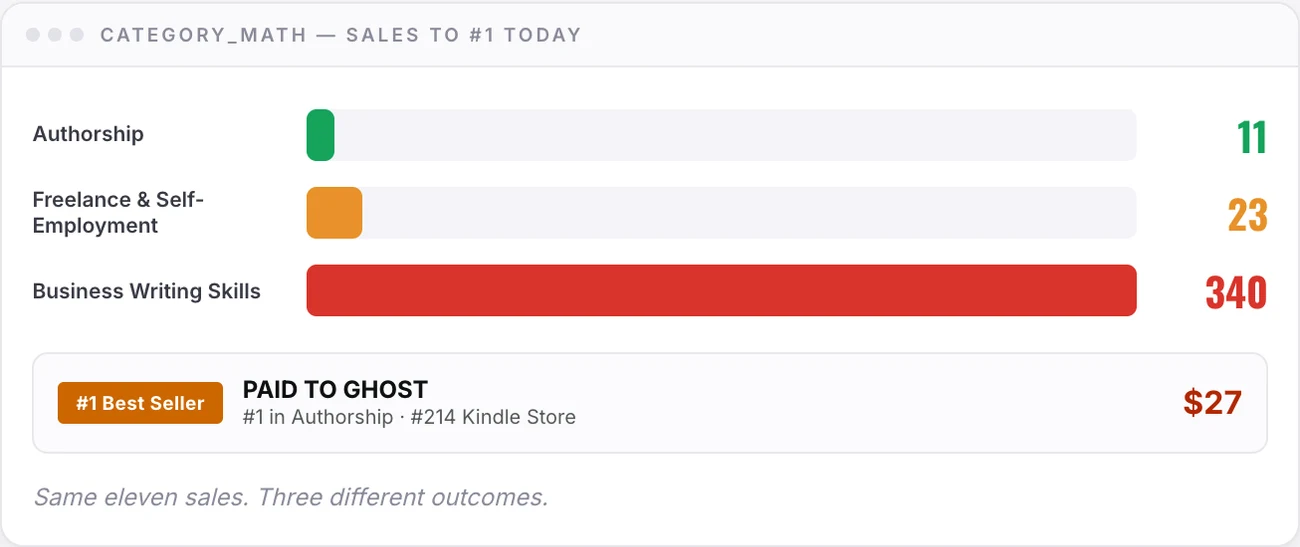
Amazon ranks books inside categories, and a book's rank is driven by velocity: sales in a tight window beat the same sales spread over a month. So reaching number one in a category is two decisions and one week. The decisions are which category the book is placed in and which keywords it's found under. That's step six, and the right metadata is everything. The week is the launch, step ten, when every sale is stacked into the same few days.
We're not telling you that number one in a category makes you rich. We're telling you it's a real, checkable result that you can put on every profile you own, and that we keep working until you have it.
What choosing a category looks like
The same sales can make a book number one in one category and leave it far down the list in another. That's step six, and it's easier to see than to describe.
If you only have an idea
You don't need a finished manuscript to start. If you have an idea and no draft, we help you write it, at the same price. Step one is "complete your manuscript," and where you're starting from just changes how much of step one there is.
What we can't supply is what you know. A book is your experience, your stories and your point of view. We can pull it out of you, shape it and write it down. We can't invent it.
Will it still be your book?
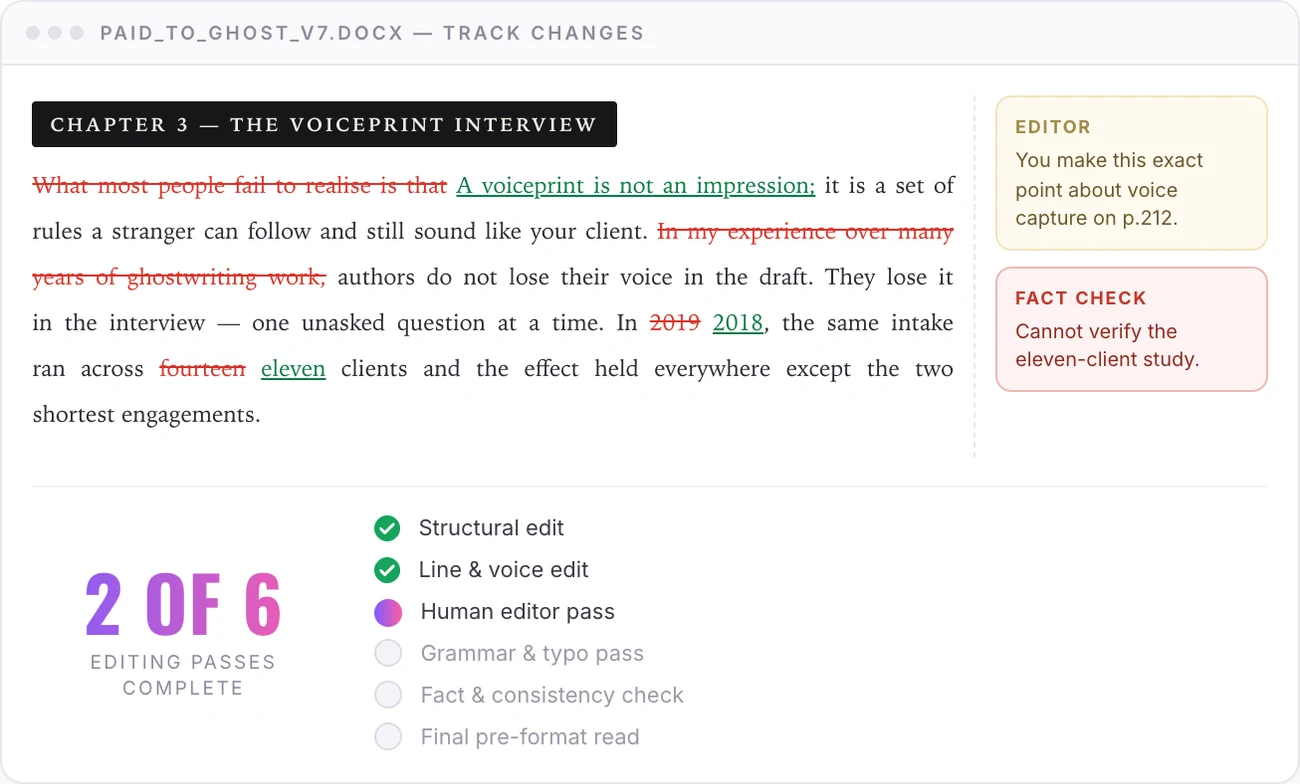
The fear under most questions about getting help is a book with your name on it that doesn't sound like you. Three things stand against it.
- The material is yours: your experience, your stories, your point of view.
- Step one includes a line-by-line edit for voice, and a human editor.
- The words are yours to approve, along with the cover and the voice.
AI makes the work faster. It isn't the author, and neither are we. If you want a book with no AI anywhere in its making, this isn't the service for you.
What's yours
The book is yours. Its manuscript is yours. Its copyright is yours. That's in the agreement, in those words. You're not signing with a publisher who takes rights or royalties. You're hiring a team to do the work, and you keep what they make.
The paperwork, and what it isn't
Step five is the one nobody warns you about: registering an imprint, buying ISBNs and assigning one to each format, generating barcodes, registering the copyright. Get it wrong and your book can't be sold.
We do that filing for you. To be clear about what it is: it's paperwork, not legal advice. We're not a law firm, and if your book raises a legal question, such as using someone else's material, that's one for a lawyer.
How it goes
- A call about your book
Where it stands: an idea, a draft, or a finished manuscript that never came out. We walk through the ten steps and what each will take for yours.
- The agreement, and one payment
$7,500, once. It doesn't renew, and your card isn't charged again.
- Onboarding
You meet the team, hand over what you have, and the work starts.
- The ten steps, in order
You approve what's yours to decide: the words, the cover, the voice. We do the rest.
- Launch week
Your list, your launch team and every buy, stacked into the same few days.
What's yours to do, and what's ours
| Part | You | Us |
|---|---|---|
| The manuscript | Bring what you know: the draft, or the idea and the stories | Help you complete it, then every edit |
| The decisions | Approve the words, the cover and the voice | Prepare each one for you to approve |
| The production | Nothing | The typesetting, the cover files, the audiobook, the registrations and the uploads |
| The launch | Be around for launch week, and go on at least one podcast | The category, the keywords, the timing and the push |
Who this is for
It's for someone whose book is part of something bigger: a business, a practice, a speaking career, a body of work. For that person a book is the most credible business card there is, and the list it builds is worth more than the royalties.
It's also for someone who simply has a book in them and has been stuck at the same place for too long.
It's probably not for someone who wants to learn publishing as a craft. If doing each of these steps yourself is the point, you should do them. The first column of that table is real.
This is for you if
- The book is part of something bigger: a business, a practice, a speaking career.
- You have a draft that has been stuck at the same place for too long.
- You have the idea and the knowledge, and no manuscript yet.
- You want one team to do all ten steps, and nobody to manage.
It isn’t, if
- Learning to publish is the point for you. Do it yourself: the first column of the table is real.
- You only need one piece, such as an edit or a cover. Hire a freelancer for it.
- You want a publisher's advance, a place on shop shelves or a national bestseller list. None is promised here.
- You expect royalties to pay the cost back quickly. Nothing here promises a number of copies.
What you might still be thinking
Is this a vanity press?
Here is how to check. A vanity press typically keeps earning from its authors: its own imprint on the book, a share of the royalties, charges that keep coming. Here the price is one payment, the imprint registered is your own, and the book, its manuscript and its copyright are yours. What we share with one is that you pay us. We aren't a publisher choosing your book on its merits. You're hiring a team.
Is a category number one a real bestseller, or a trick?
It's real, and narrower than the word suggests. Amazon ranks every book inside its categories, and anyone can open your book's page and see the rank. Step six says it plainly: in the right category it can take about ten sales. So this is not a national bestseller list, and not a promise of copies sold. If you'd feel uneasy putting it on your profile, don't buy for that reason.
What exactly does the guarantee cover?
Read it literally, because it's one sentence. If your book does not hit #1 in its category on Amazon, we keep working until it does. It names one result and one remedy: more work from us. It says nothing about a date, a number of copies or any other list, so don't read those into it.
How long will it take?
There's no date on this page, because it depends on where your manuscript is. A finished one skips most of step one. An idea starts at the beginning of it. If you need the book out by a particular date, say so on the call before you decide. If nobody will commit to that date, don't buy on the hope of it.
Do you take a share of my sales?
No. It's one payment and it doesn't renew. You're not signing with a publisher who takes rights or royalties: you're hiring a team and keeping what they make. You can read the agreement before you sign, and you should. With any publishing company, the paragraph about rights and royalties is the one to read twice.
I don't have a following. Can a launch work without one?
It's harder, and you should know why. Launch week stacks sales from your list, your affiliates and your launch team into the same few days. The fewer people you can reach, the more rests on the choice of category. Steps eight and nine build the list you don't have yet. If you couldn't name a handful of people who'd buy your book in its first week, say that on the call.
Does it include advertising after the launch?
No. The ten steps end with launch week and your first podcast. Paid advertising isn't one of them, and neither is a long run of interviews. What you have afterwards is the equipment: an author site, a list of readers and a CRM, which is how the next thing you publish reaches the people who bought the first.
How do I check any of this before I pay?
Three things here can be checked, not just believed. The ten steps are listed above, so you can hold what's delivered against them one by one. The ownership is in the agreement, which you can read before you sign. And the result is public: a book's category rank is shown on its Amazon page.
Questions people ask
I haven't finished writing. Can I start?
Yes. We help you complete it, whether you have a draft or just the idea, at the same price.
Who owns the book?
You do: the book, its manuscript and its copyright. It's written into the agreement.
Is the $7,500 really everything?
It's one payment for the ten steps on this page. It doesn't renew and your card isn't charged again.
What does "number one" actually mean?
Number one in your book's category on Amazon. It's a specific, checkable ranking, and if the book doesn't reach it we keep working until it does.
Do I have to record the audiobook myself?
No. Step four covers it: selecting the voice talent, then recording, editing and publishing the audiobook.
Where will the book be sold?
On Amazon, Apple Books, Barnes & Noble and your own website. Step seven is making sure the buy button works on each.
Why do I need a website and a CRM for a book?
Because every buyer should become a subscriber. A funnel collects names; a CRM is what stops them falling through the cracks. That list is how the second book sells.