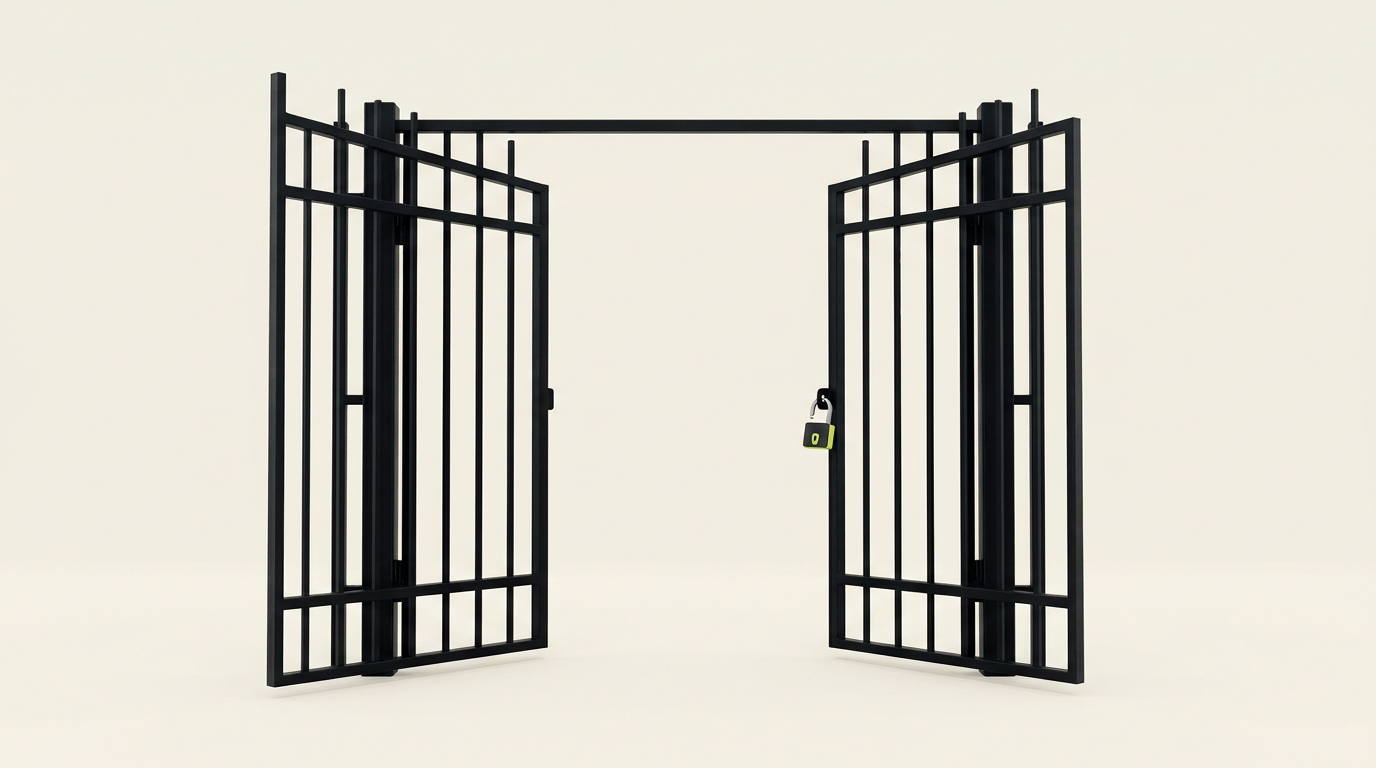
There's an image I keep coming back to. A tall iron gate — ornate, hinged, padlocked — standing in the middle of an empty field.
No wall on either side. No fence running away from it in either direction. Just a gate, bolted shut, guarding nothing. And a worn path leading up to it.
The path is the part that matters. Somebody walked up to that gate often enough to wear a line in the grass. They walked to the locked door, stopped, and went back the way they came. Then they did it again the next day, while the whole field sat open either side of them.
I've never seen a better portrait of the last decade of building things.
The gate was real
It's fashionable now to call the old order gatekeeping — an elite protecting its access out of self-interest. That reading feels good and it's mostly wrong. And the reason it's wrong matters, because a villain is easier to wait out than a structure.
For most of my working life, getting software built took several specialists at once. A designer. An engineer. Someone to run the infrastructure. Someone to sell the finished thing. And a person to hold the whole affair together and keep it pointed in one direction.
None of those people were rare on their own. All of them were expensive in combination, and every one had to be paid every month while the outcome was still unknown.
That distinction isn't a technicality. A conspiracy is a moral story, and moral stories have villains, and villains can be shamed or replaced or outlasted. Arithmetic is a structural story with a price attached. Until the price changed, no amount of deserved frustration moved the gate an inch.
Which means everyone who stood at that gate and quietly decided the thing they wanted wasn't for them was reading the situation correctly. That's what makes it worth revisiting now.
What the gate actually charged
The fee was never the money. Money was just the visible part of the invoice.
The real charge was the idea.
Say you had a clear picture — a specific tool for a job you did every week, a specific book you wanted to exist, a specific way of handling scheduling that was obviously better than the way everyone handled it. To get it built, you had to hand that picture to strangers and hope it survived the journey.
It rarely did. The picture became a brief. The brief became requirements. The requirements became estimates, the estimates became a scope, the scope became a queue of work — and the queue became something that shipped late and didn't match what you'd imagined.
Every step in that chain is a translation, and every translation loses precision. Nobody in the chain is incompetent. Nobody deletes your vision on purpose. It just erodes, like a sentence whispered down a line of ten people, except the game runs for eight months and costs a small fortune to play.
The gate charged money. The translation charged the idea. And the idea was the only irreplaceable part.
What removed the wall
Sometime in the last few years, the arithmetic changed.
Not because anyone opened the gate. Not because anyone declared it open. Because the cost of producing the work collapsed.
The parts of building that were pure production — the boilerplate, the first draft, the layout, the rough cut, the setup, the testing, the twenty small technical chores that fill the space between an idea and a finished thing — got fast. And the fast parts were exactly the parts that made a crowd necessary.
Building anything meant assembling expensive specialists and paying them every month while the answer was still unknown. Capital was the entry fee.
The same work, without the crowd. The barrier is gone. What is left is the habit of queuing at it.
The part nobody warns you about
When the gate opens, almost nobody walks through. That's the honest finding, and it isn't a criticism of anybody.
We're trained to wait for permission. Not by a villain — by a lifetime of queues that were real. School, hiring, funding, publishing, the bank. Every one of those taught the same lesson: the decision isn't yours, wait your turn, and the turn will be granted by somebody else.
So when the wall comes down, the first thing most people do is keep standing at the gate, waiting for someone to tell them it's fine.
Nobody's going to. There's no queue to legitimise the decision anymore, and that's uncomfortable in a way that's easy to mistake for a reason to wait. It isn't. It's just the feeling of being the first one through.
The new constraint
If permission isn't the blocker, what is?
- Clarity. Do you actually know what you want, specifically enough that somebody could build it without asking a follow-up question?
- Willingness to act without a queue. Can you decide before someone else tells you the decision is reasonable?
- Tolerance for being early. Nobody's going to validate it for you, because most people are still standing at the gate.
Notice that all three of those are yours. Not capital, not credentials, not a team you can't afford. The gate is gone and what's left is a decision.
- The gate was real
It was arithmetic, not a conspiracy — which is why waiting never helped.
- The price changed
The production work that required a crowd is now fast, so the gate no longer guards anything.
- The new cost
Waiting used to cost capital you did not control. Now it costs time, and the time is yours.
The cost of waiting used to be paid in capital, which you didn't control. It is now paid in time, which you do.
That's the entire change, and everything about how you should behave follows from it.